About QuantBayes
Evidence verification for shared results.
QuantBayes Studio helps accountable teams show the evidence behind a result before that result is trusted, shared, reused, or acted on. It is designed for settings where conclusions may come from people, pipelines, institutions, or AI systems, but where the evidence requirements, completed checks, missing information, and contradictions must remain inspectable.
What it does
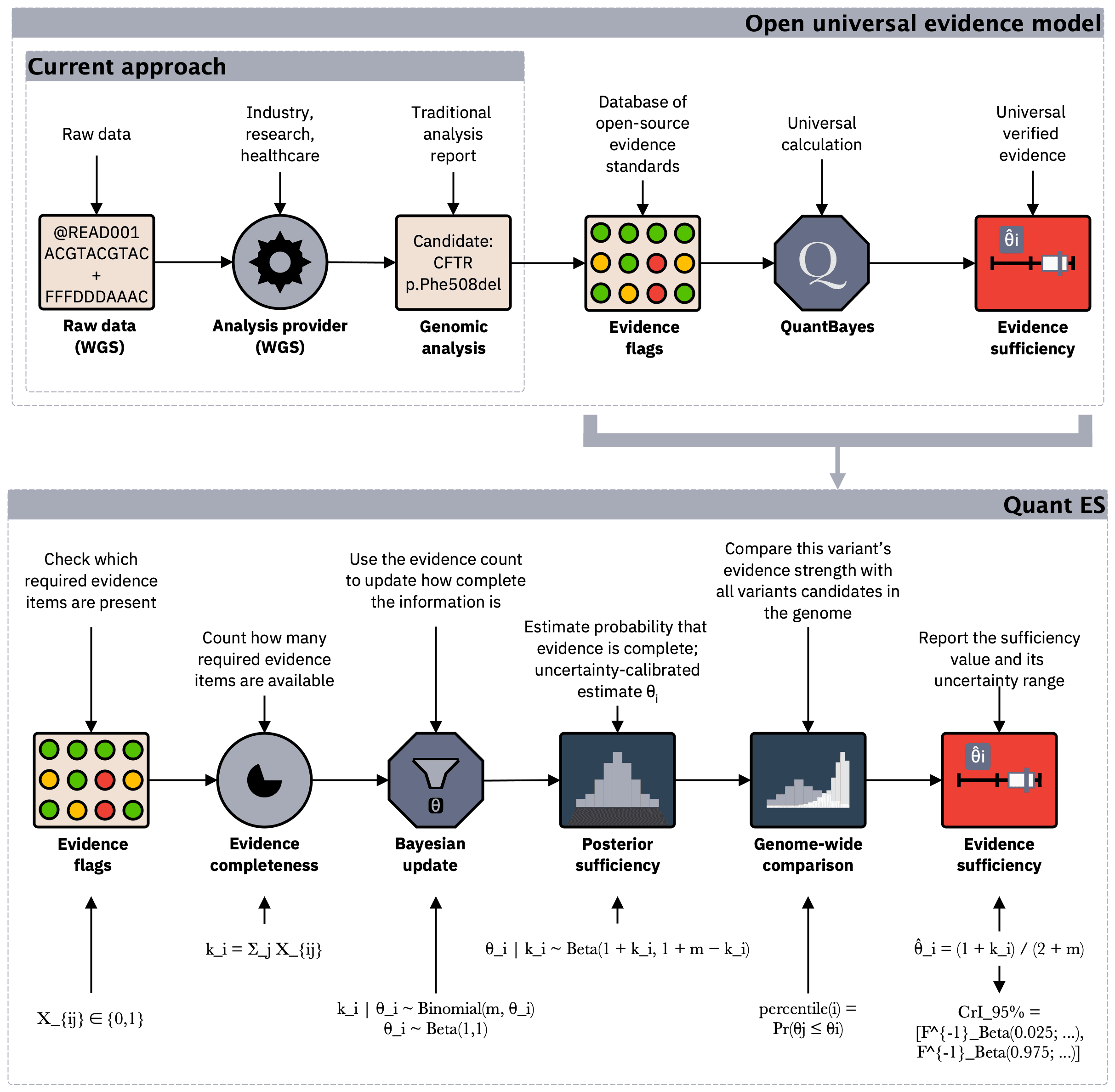
A profile defines the evidence rules. A case records the items being evaluated. A matrix records whether each rule was satisfied. The QuantBayes engine then estimates evidence sufficiency with uncertainty, preserving a result that can be reviewed, compared, and reused under declared rules.
QuantBayes does not decide whether a result is true. It does not replace expert judgement, domain-specific review, or the original analysis system. It measures a narrower question: how complete is the verifiable evidence under the rules that were declared in advance? This keeps the result tied to the checklist, the checked evidence, and the uncertainty around what is still missing.
Origin and standard
QuantBayes grew from open research on verifiable evidence in genomics. The original problem was structural: medical genetics requires verifiable assessments of DNA using several tests. However, laboratories and pipelines may assess features including genetic inheritance, population frequency, phenotype fit, and technical evidence differently, which makes results difficult to compare, audit, or reuse across institutions. The main algorithms were developed through work at EPFL, the University of Zurich, the University Children's Hospital Zurich, and collaborating clinical and research groups: Quant Group, et al. A Bayesian model for quantifying genomic variant evidence sufficiency in Mendelian disease. medRxiv 2025.12.02.25341503. doi: https://doi.org/10.64898/2025.12.02.25341503. The QEM normative standard is cited as: Swiss Genomics Association. (2025). Qualifying Evidence Matrix standard for verifiable evidence (SGA-QEM-1.0). Zenodo. https://doi.org/10.5281/zenodo.17936587. The standard PDF and HTML is available at the latest SGA-QEM-1.0 release.
Statistical basis
QuantBayes operates on a binary evidence matrix. Rows are the items being evaluated, such as claims, findings, decisions, or candidate results. Columns are the evidence rules. Each entry Xij is 1 when rule j is satisfied for item i, and 0 when the required evidence is absent, unavailable, or contradicted. Missing information never increases evidence support.
For item i, the evidence count is ki = ΣXij, and m is the number of evaluated rules. QuantBayes defines θi as the evidence sufficiency parameter: the probability that a randomly selected evidence rule is satisfied for item i. The model uses ki | θi ∼ Binomial(m, θi) with θi ∼ Beta(1, 1), giving the posterior θi | ki ∼ Beta(1 + ki, 1 + m − ki).
The reported outputs are the posterior mean of θi, its credible interval, and the percentile Pr(θj ≤ θi) relative to the wider evaluated evidence landscape. This gives each result an uncertainty-calibrated evidence estimate and a reference point against other evaluated items.
Engine, platform, and organisation
The QuantBayes engine implements the Bayesian evidence sufficiency calculation and operates on evidence matrices without requiring access to private pipeline internals, proprietary scoring methods, genotype data, or sensitive source data. The reference implementation is released separately as open source software under the MIT licence.
QuantBayes Studio is the hosted platform built around that model. It manages profiles, cases, evidence matrices, runs, reports, APIs, account access, audit trails, and team workflows. QuantBayes Profiles are reusable public or private evidence rule sets maintained by teams, organisations, or communities.
Switzerland Omics is the commercial owner, operator, host, and licensing provider for QuantBayes Studio. Its role is to maintain the production platform, support deployment, provide commercial access, and help organisations apply evidence profiles in real workflows.